

Best Winter Flowering Plants for Year-Round Color
Who says winter gardens have to be brown and dreary? While most plants go dormant when temperatures drop, there’s a surprisingly diverse selection of beautiful flowering plants that actually bloom during the coldest months. These winter warriors provide vibrant color, delicate fragrance, and visual interest precisely when you need it most.
Table Of Content
- Why Grow Winter Flowering Plants?
- Witch Hazel (Hamamelis): The Star of Winter Blooms
- Hellebores (Christmas Rose/Lenten Rose): Elegant and Easy
- Winter Jasmine (Jasminum nudiflorum): Cheerful Yellow Cascades
- Pansies and Violas: Cold-Hardy Classics
- Snowdrops (Galanthus): First Sign of Spring
- Winter Aconite (Eranthis hyemalis): Bright Golden Carpets
- Camellias: Evergreen Elegance
- Winter Heath and Heather (Erica and Calluna): Carpets of Color
- Primrose (Primula): Cottage Garden Charm
- Cyclamen (Hardy Cyclamen coum): Delicate and Durable
- Mahonia (Oregon Grape): Architectural Winter Beauty
- Daphne odora (Winter Daphne): Intoxicating Fragrance
- Creating a Winter Flowering Garden
- Final Thoughts
Whether you’re looking to brighten up containers near your front door, add color to garden beds, or simply enjoy something blooming when everything else is asleep, this guide covers the best winter flowering plants for cold climates. We’ll explore both traditional favorites and lesser-known gems, complete with growing tips and design ideas.
Why Grow Winter Flowering Plants?
Before diving into specific plants, let’s talk about why winter bloomers deserve space in your garden:
Mental health boost: Seeing flowers bloom in winter lifts spirits during dark, cold months. The splash of color combats seasonal affective disorder and reminds us that spring will return.
Early pollinator support: Winter bloomers provide crucial food for early-emerging bees and other pollinators on warm winter days.
Year-round interest: Strategic planting of winter bloomers ensures your garden looks attractive 12 months a year, not just spring through fall.
Unique beauty: Winter flowers often have a delicate, refined quality that summer bloomers lack. Their subtle beauty stands out against stark winter landscapes.
Witch Hazel (Hamamelis): The Star of Winter Blooms
Witch hazel is arguably the most spectacular winter-flowering shrub, producing ribbon-like flowers in shades of yellow, orange, and red even in frigid temperatures.
Bloom time: December through March depending on variety. Flowers are frost-resistant and last for weeks.
Growing conditions: Prefers partial shade to full sun. Needs acidic, well-drained soil rich in organic matter. Hardy to zone 5 (some varieties to zone 3).
Size: Grows 10-20 feet tall and wide at maturity. Can be pruned to smaller size or trained as small tree.
Standout features: Fragrant blooms with spicy-sweet scent. Excellent fall foliage in shades of yellow, orange, and red. Deer resistant.
Best varieties: ‘Arnold Promise’ (bright yellow, very fragrant), ‘Diane’ (deep red flowers), ‘Jelena’ (orange-copper blooms), ‘Pallida’ (pure yellow, extremely hardy).
Design tips: Plant near windows or pathways where you’ll appreciate fragrance. Underplant with snowdrops and winter aconite for layered interest. Excellent specimen plant or hedge.
Hellebores (Christmas Rose/Lenten Rose): Elegant and Easy
Hellebores are the workhorses of the winter garden, blooming from late winter into spring with nodding flowers in sophisticated colors.
Bloom time: Christmas rose (H. niger) blooms December-February. Lenten rose (H. orientalis) blooms February-April.
Growing conditions: Shade to partial shade. Tolerates dry shade once established. Prefers rich, well-drained soil. Hardy zones 4-9.
Size: Low-growing perennial, 12-18 inches tall and wide.
Standout features: Evergreen foliage provides year-round structure. Flowers last 6-8 weeks. Deer and rabbit resistant. Self-seeds to form colonies over time.
Colors available: White, cream, pink, purple, green, spotted, picotee edges. New hybrids offer double flowers and unique color combinations.
Care tips: Remove old, tattered leaves in late winter before flowers emerge. Mulch lightly. Division rarely needed. Be patient—hellebores take 2-3 years to establish and bloom well.
Design tips: Perfect for woodland gardens. Plant in groups of 3-5 for impact. Combine with ferns, hostas, and other shade lovers. Excellent under deciduous trees.
Winter Jasmine (Jasminum nudiflorum): Cheerful Yellow Cascades
Winter jasmine brings sunshine-yellow flowers to the bleakest winter days. Its arching stems create a fountain of color.
Bloom time: November through March in mild winters. Flowers appear on bare stems before leaves.
Growing conditions: Full sun to partial shade. Tolerates almost any soil. Very adaptable and low-maintenance. Hardy zones 6-10.
Size: Grows 4 feet tall, spreads 7 feet wide. Can be trained as climber with support.
Standout features: Bright yellow flowers open on warm winter days. Vigorous, fast-growing. Tolerates urban pollution. Unscented (unlike summer jasmine).
Care tips: Prune after flowering to control size and shape. Stems root where they touch ground—can spread aggressively if not managed. Tie to support for vertical growth.
Design tips: Excellent for cascading over walls or banks. Train on fences or trellises. Plant where bare winter branches are visible from house. Looks beautiful contrasted with evergreens.
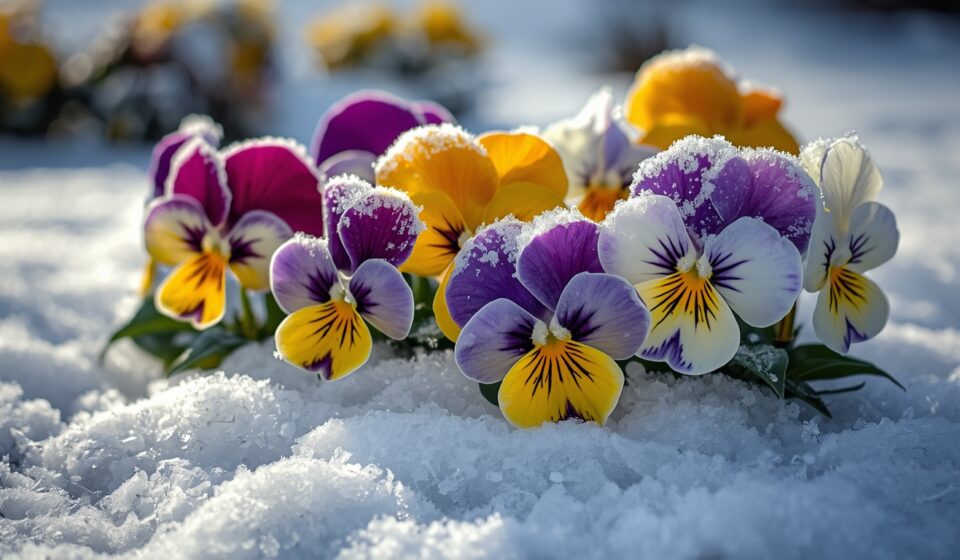
Pansies and Violas: Cold-Hardy Classics
Modern pansy varieties are surprisingly cold-tolerant, blooming throughout winter in zones 6-9 and coming back strong in colder zones.
Bloom time: Fall through spring. In mild climates, bloom continuously. In cold climates, stop during deep winter but resume in late winter.
Growing conditions: Full sun to partial shade. Well-drained soil enriched with compost. Hardy to zone 4 (with protection).
Size: Compact plants 6-9 inches tall and wide.
Standout features: Incredible color range—virtually every color and combination imaginable. “Faces” add character. Edible flowers for salads and garnishes.
Best varieties for winter: ‘Icicle’ series (extra cold-hardy), ‘Frosty Rose’, ‘Winter Sun’, ‘Ice Pansy’ series, Violas (smaller flowers, even hardier than pansies).
Care tips: Deadhead regularly to encourage more blooms. Mulch around plants in severe climates. Water during dry winter periods. Fertilize lightly monthly.
Design tips: Perfect for containers near entrances. Edge pathways and borders. Mix colors for cottage garden charm or use single colors for sophisticated look. Combine with early bulbs.
Snowdrops (Galanthus): First Sign of Spring
These delicate bulbs often push through snow to bloom, making them one of the earliest and most beloved winter flowers.
Bloom time: Late January through March depending on variety and location.
Growing conditions: Partial shade to full shade. Moist but well-drained soil. Goes dormant after flowering. Hardy zones 3-7.
Size: Tiny plants 3-6 inches tall.
Standout features: Pure white drooping flowers. Naturalizes over time, forming carpets. Requires virtually no care once established. Fragrant (subtle honey scent).
Planting: Plant bulbs “in the green” (freshly dug while in leaf) for best results. Mail-order bulbs can be unreliable. Spring is planting time, not fall like most bulbs.
Popular varieties: Common snowdrop (G. nivalis), Giant snowdrop (G. elwesii, earlier and larger), Double snowdrop (G. nivalis ‘Flore Pleno’).
Design tips: Plant in drifts under deciduous trees. Combine with winter aconite for extended bloom. Edge woodland paths. Plant where you’ll see them from windows during bad weather.
Winter Aconite (Eranthis hyemalis): Bright Golden Carpets
Winter aconite blooms right alongside snowdrops, creating a cheerful golden carpet that announces winter’s end.
Bloom time: Late winter (February-March). One of the earliest bloomers.
Growing conditions: Full sun to partial shade. Well-drained soil. Tolerates clay soil better than many early bulbs. Hardy zones 4-7.
Size: Tiny plants 3-4 inches tall.
Standout features: Bright yellow cup-shaped flowers with green ruff. Self-seeds freely once established. Early food source for bees.
Planting tips: Soak dried tubers overnight before planting. Plant in fall 2-3 inches deep. Plant in groups of 25+ for impact. Patience required—can take a year to establish.
Design tips: Spectacular massed under deciduous shrubs. Pairs beautifully with snowdrops—plant together. Allows spring ephemerals and later perennials to grow through it.
Camellias: Evergreen Elegance
Camellias produce show-stopping flowers throughout winter and early spring while providing year-round evergreen structure.
Bloom time: Fall through spring depending on variety. Sasanqua types bloom fall-early winter. Japonica types bloom mid-winter through spring.
Growing conditions: Partial shade. Acidic, well-drained soil. Protection from strong winds. Hardy zones 6-10 (some varieties to zone 6).
Size: Varies by variety from 6-12 feet tall shrubs to 20+ foot trees.
Standout features: Elegant rose-like or peony-like flowers. Glossy evergreen foliage. Long bloom period. Shade tolerant.
Best varieties: C. sasanqua ‘Yuletide’ (red, very cold-hardy), C. japonica ‘April Dawn’ (pink with white markings), ‘Winter’s Snowman’ (white, fragrant).
Care tips: Mulch well. Water during dry periods. Fertilize with acid-loving plant food. Minimal pruning needed. Protect from harsh winter winds.
Design tips: Foundation plantings. Woodland gardens. Espalier against walls. Container specimens. Underplant with ferns and hostas.
Winter Heath and Heather (Erica and Calluna): Carpets of Color
These low-growing evergreen shrubs provide winter color through flowers and foliage, creating beautiful ground covers.
Bloom time: Winter heath blooms November-April. Foliage provides year-round color.
Growing conditions: Full sun to light shade. Well-drained, acidic soil. Excellent drainage essential. Hardy zones 5-7.
Size: Low-growing, 6-12 inches tall, spreading 12-24 inches wide.
Standout features: Covers large areas with color. Minimal care required. Deer resistant. Provides winter interest through bloom and foliage color.
Popular varieties: ‘Springwood Pink’, ‘Springwood White’, ‘Kramer’s Rote’ (magenta flowers), ‘Ghost Hills’ (white flowers, chartreuse foliage).
Care tips: Shear lightly after flowering to maintain compact shape. Mulch with pine needles or bark. Don’t over-fertilize. Water during establishment then drought-tolerant.
Design tips: Mass plantings for ground cover. Rock gardens. Slopes and banks. Combine varieties with different bloom times and foliage colors.
Primrose (Primula): Cottage Garden Charm
Primroses bring old-fashioned charm and brilliant colors to late winter and early spring gardens.
Bloom time: Late winter through spring (February-May depending on variety).
Growing conditions: Partial shade. Moist, rich soil. Cool temperatures. Hardy zones 4-8.
Size: Compact rosettes 6-12 inches tall and wide.
Standout features: Vibrant color range. Easy to grow. Affordable. Some varieties fragrant. Self-seeds in favorable conditions.
Best types: English primrose (P. vulgaris), Polyanthus primrose (P. x polyantha, more flowers per stem), Drumstick primrose (P. denticulata, ball-shaped flowers).
Care tips: Keep soil evenly moist. Mulch to retain moisture. Divide every 2-3 years after flowering. Can be grown as annuals in hot climates.
Design tips: Edge borders and pathways. Woodland gardens. Rock gardens. Containers. Naturalize in lawns (where unmowed in early spring). Pair with ferns and hostas.
Cyclamen (Hardy Cyclamen coum): Delicate and Durable
Don’t confuse these with tender florist cyclamen. Hardy cyclamen are tough perennials that bloom in winter’s coldest weather.
Bloom time: December through March.
Growing conditions: Partial to full shade. Well-drained soil. Grows well under trees and shrubs. Hardy zones 5-9.
Size: Small plants 3-4 inches tall. Tubers slowly increase in size over years.
Standout features: Dainty flowers in pink, white, or magenta. Beautiful silver-patterned leaves (ornamental even when not blooming). Self-seeds. Deer and rodent resistant.
Planting: Plant tubers shallowly (just barely covered). Don’t move once established—they resent disturbance.
Design tips: Naturalize under deciduous trees. Rock gardens. Fairy garden additions. Allow to self-seed into cracks and crevices. Pairs well with hellebores and early bulbs.
Mahonia (Oregon Grape): Architectural Winter Beauty
This bold evergreen shrub produces clusters of fragrant yellow flowers in late winter, followed by edible blue berries.
Bloom time: Late winter through early spring (January-March).
Growing conditions: Partial shade to full sun. Adaptable to most soils. Drought-tolerant once established. Hardy zones 5-9.
Size: Varies by species: 3-6 feet (M. aquifolium) to 10-12 feet (M. x media).
Standout features: Fragrant yellow flowers. Architectural foliage (holly-like, spiny leaves). Blue berries attract birds. Bronze winter foliage color.
Best varieties: M. aquifolium ‘Compacta’ (compact grower), M. x media ‘Charity’ (tall, very fragrant), M. ‘Soft Caress’ (no spines!).
Design tips: Foundation plantings. Wildlife gardens. Shade gardens. Barrier plantings (spiny leaves deter traffic). Specimen plants.
Daphne odora (Winter Daphne): Intoxicating Fragrance
If you can only grow one winter-flowering shrub, many gardeners choose winter daphne for its incredible fragrance that perfumes the entire garden.
Bloom time: Late winter (January-March).
Growing conditions: Partial shade. Well-drained, slightly alkaline soil. Resents root disturbance. Hardy zones 7-9.
Size: Compact evergreen shrub 3-4 feet tall and wide.
Standout features: Intensely fragrant pink or white flowers. A few flowers perfume large areas. Evergreen foliage (variegated forms available). Deer resistant.
Care tips: Plant where it won’t need moving—daphnes hate root disturbance. Excellent drainage essential. Don’t over-fertilize. Minimal pruning needed.
Design tips: Plant near windows, doors, or pathways where fragrance can be appreciated. Containers near entrances. Combine with other winter bloomers.
Creating a Winter Flowering Garden
Layer bloom times: Select plants that bloom at different times throughout winter. Early (December-January): witch hazel, camellia. Mid-winter (January-February): hellebores, daphne, mahonia. Late winter (February-March): primrose, winter aconite, snowdrops.
Provide viewing opportunities: Plant winter bloomers where you’ll see them from windows. Create paths that invite winter walks through the garden. Place containers near frequently used doors.
Add evergreens for structure: Combine winter bloomers with evergreen shrubs and conifers. The evergreen backdrop makes flowers stand out. Provides year-round structure.
Consider fragrance placement: Plant fragrant varieties near outdoor living areas, windows, and entrances. Even brief exposure to winter garden when fetching mail becomes delightful.
Group for impact: Mass plantings of winter bloomers create more visual impact than scattered plants. Plant in groups of 3, 5, or 7 for natural look.
Final Thoughts
Winter doesn’t have to mean a colorless garden. With careful selection of cold-hardy flowering plants, you can enjoy blooms throughout the dormant season. From the architectural beauty of hellebores to the sweet fragrance of daphne, winter bloomers offer something special precisely when we need it most—a reminder that life persists even in the coldest weather, and spring is always coming.
Start with one or two varieties that appeal to you and suit your growing conditions. Over time, build a collection of winter bloomers that extends the season and provides year-round interest. Your winter garden will become a source of joy and inspiration during the quiet months, proving that with the right plants, every season can be beautiful.